Web Application Penetration Testing
Manual testing for authentication flaws, broken access control, injection, data exposure, and business logic weaknesses.
Offensive Security Consulting
Segmentation Fault Labs delivers attacker-informed penetration testing and security consulting to help teams identify exploitable weaknesses, understand business risk, and strengthen defenses before adversaries get the chance.

Security testing for applications, infrastructure, APIs, cloud environments, and exposed attack surfaces.
We focus on vulnerabilities that matter: the issues an attacker can exploit, the paths that expose sensitive data, and the controls that need to be strengthened.
Focused assessments for applications, infrastructure, exposed assets, and engineering teams that need credible technical assurance.
Manual testing for authentication flaws, broken access control, injection, data exposure, and business logic weaknesses.
External and internal testing to validate exposure, privilege escalation paths, segmentation, and infrastructure hardening.
Assessment of REST, GraphQL, and backend services for abuse paths, authorization gaps, and sensitive data exposure.
Review of identity, permissions, public exposure, storage controls, logging, and security-critical configuration.
Source-level analysis to identify risky patterns, logic flaws, insecure dependencies, and implementation defects.
Testing for mobile apps, backend APIs, local storage, authentication flows, transport security, and platform-specific risks.
Operationalize findings with proof-of-concept validation, Semgrep rules, and Nuclei templates your team can integrate into security workflows.
Security findings only matter when they are accurate, understandable, and fixable. Our reporting is written for leadership and technical teams.
We test from the perspective of a real adversary and prioritize exploitable risk over scanner noise.
Findings are mapped to impact, likelihood, affected assets, and remediation priority.
Reports include reproduction steps, technical evidence, and guidance your team can use immediately.
Engagements can be delivered remotely with structured access, communication, reporting, and retesting.
Open-source utilities for security teams that want to turn findings into repeatable detection and validation workflows.
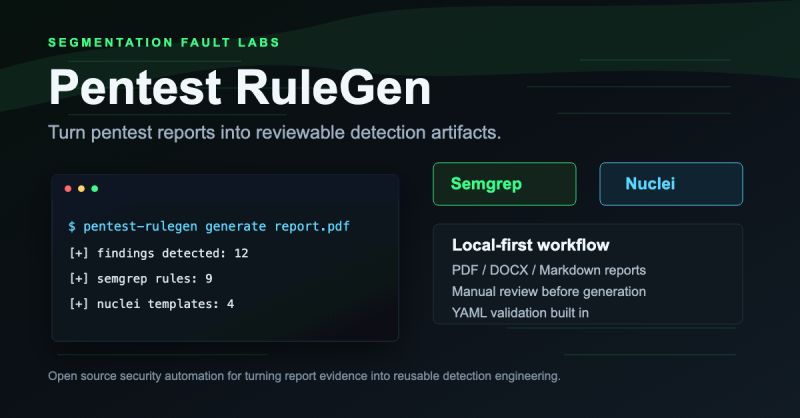
Pentest RuleGen
Pentest RuleGen is a local-first tool that extracts findings and proof-of-concept evidence from reports, then helps generate reviewable detection engineering artifacts.
Tell us what you need tested and what risk you are trying to reduce.